Local Stability Analysis of an Infection-Age Mathematical Model for COVID-19 Disease Dynamics
Ogwede, Daniel Obakesa *
Department of Mathematics, Federal College of Education Technical, Isu, Ebonyi, Nigeria.
AGBO Christiana Ene
Department of Mathematics, University of Abuja, Abuja, Nigeria.
Iro Chibuike
Department of Mathematics, Federal College of Education Technical, Isu, Ebonyi, Nigeria.
*Author to whom correspondence should be addressed.
Abstract
The infectiousness of individuals with an acute respiratory infection can vary with time since entry into the infectious stage, motivating epidemic models that retain infection-age structure rather than treating all infectious individuals as epidemiologically identical. This study formulates and analyses an infection-age-structured model for COVID-19 disease dynamics with susceptible, vaccinated, exposed, infection-age-structured infectious, and recovered populations. New infectious individuals enter the structured infectious class only after progression from the exposed class, so that the boundary condition is i(0,t) = gE(t). Transmission, recovery, and disease-induced mortality may depend on infection age. An explicit basic reproduction number is obtained as; 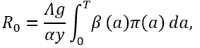
where Λ = (1-b)p, α = θ+μ, y = μ+g, and π(a) is the probability of remaining infectious to infection age a . The disease-free equilibrium is locally asymptotically stable when R0<1 and unstable when R0>1; a positive endemic equilibrium exists when R0>1. For the illustrative parameter set used in the numerical analysis, the baseline value is R0=0.4694. Multiplying the transmission kernel by three gives R0=1.4081 and produces persistent infection in the corresponding numerical trajectory. The normalised functional sensitivity density, \(β(a)π(a)/∫_0^Tβ (s)π(s) ds,\) attains its maximum at approximately 2.49 days for the specified kernels, indicating that early infection ages make the largest model-specific contribution to . This peak is a property of the assumed mathematical functions and should not be interpreted as a direct empirical estimate of the biological peak of SARS-CoV-2 infectiousness. The results illustrate how infection-age structure can identify temporal contributions to epidemic transmission while retaining a transparent threshold criterion for local disease invasion.
Keywords: Basic reproduction number, COVID-19, disease-free equilibrium, functional sensitivity analysis, infection age, infection-age-structured model, local asymptotic stability, mathematical modelling, numerical simulation, vaccination